

Electric Roller Shutters and Doors for Shops and Commercial Premises
London Shop Fronts makes and fits electric roller shutters and electric roller doors for shops, restaurants, offices, and commercial units, in London and on projects across the UK. Every quote follows a survey of your opening, and our after-sales support carries on once the shutter has been installed.
Our shop front shutters are made in our UK factory and fitted by our own team. Call 020 7112 9119 or book a survey.






25+ years' experience
Decades of industry experience ensuring quality craftsmanship and reliability.
Nationwide projects
Delivering electric roller shutters and doors to businesses across the UK.
Fast project completion
Efficient turnaround times to get your storefront ready without delays.
At a glance
Shutter types
Solid, perforated, punched, polycarbonate, and rolling grill, all available with electric operation
Motors
Tubular motors on most shutters; 240V single-phase on polycarbonate
Controls
Wall switch, key switch, keypad, remote, timer, motion sensor, or smart device
Power cut
Manual override
Finishes
Powder-coated in any RAL colour
Coverage
London and nationwide
Approvals
CHAS approved

What Are Electric Roller Shutters?
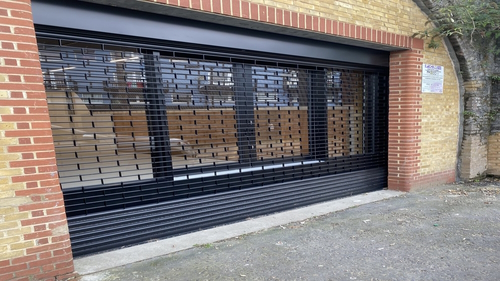
Electric roller shutters are roller shutters raised and lowered by an electric motor rather than by hand. On most of the shutters that London Shop Fronts fits, we use a tubular motor run from a key switch or a remote fob, so the shop front opens or closes at the press of a button.
You’ll see electric shutters on high street shops and bar counters, and often on factory and warehouse doors too. We fit electric operation as standard on most of our shutters. Manual versions are there if you’d rather keep the cost down or have other specific needs.
Types of Electric Shutters for Shops and Shop Fronts
Electric shop shutters from London Shop Fronts come in five types, and the choice mostly depends on how much of your window you want people to see after closing. A solid shutter hides everything, for example, while a polycarbonate shutter leaves around three-quarters of the window on view.
Your council may narrow the choice for you, so read the planning section below before you settle on one. These are the five types of electric shutters for shops:
Solid Roller Shutters
Solid roller shutters form a continuous aluminium curtain, so nothing behind them is on show once they’re down, which makes them the most private option. However, they can sometimes be less popular with councils, as visibility into shop windows is blocked when the shutters are down.
Perforated Shutters
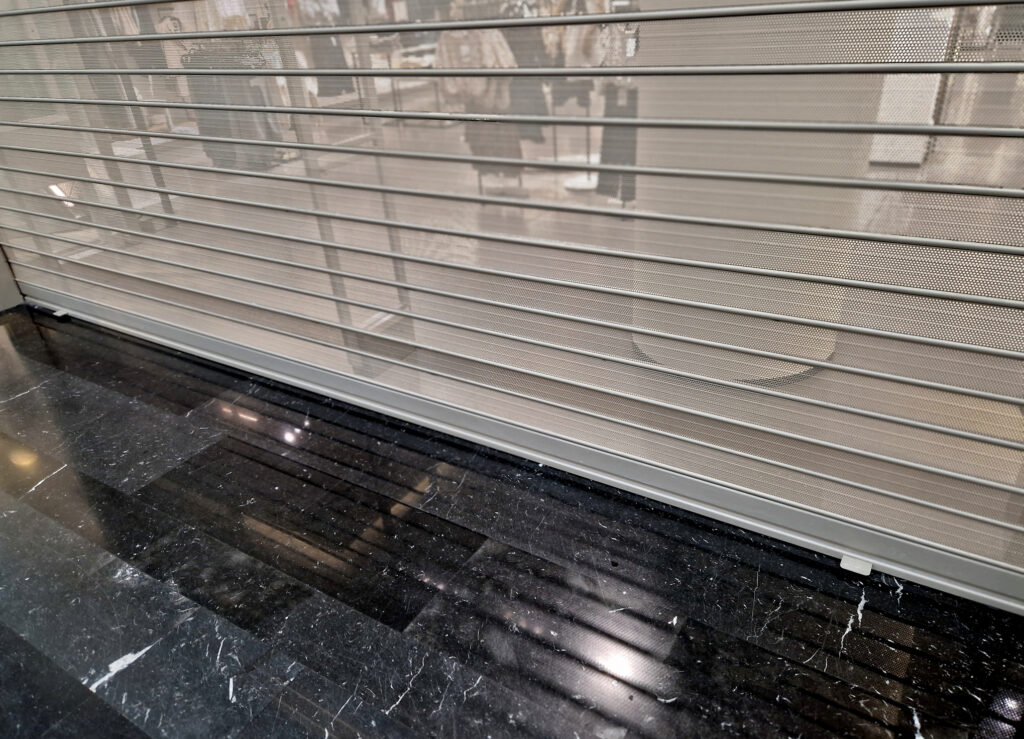
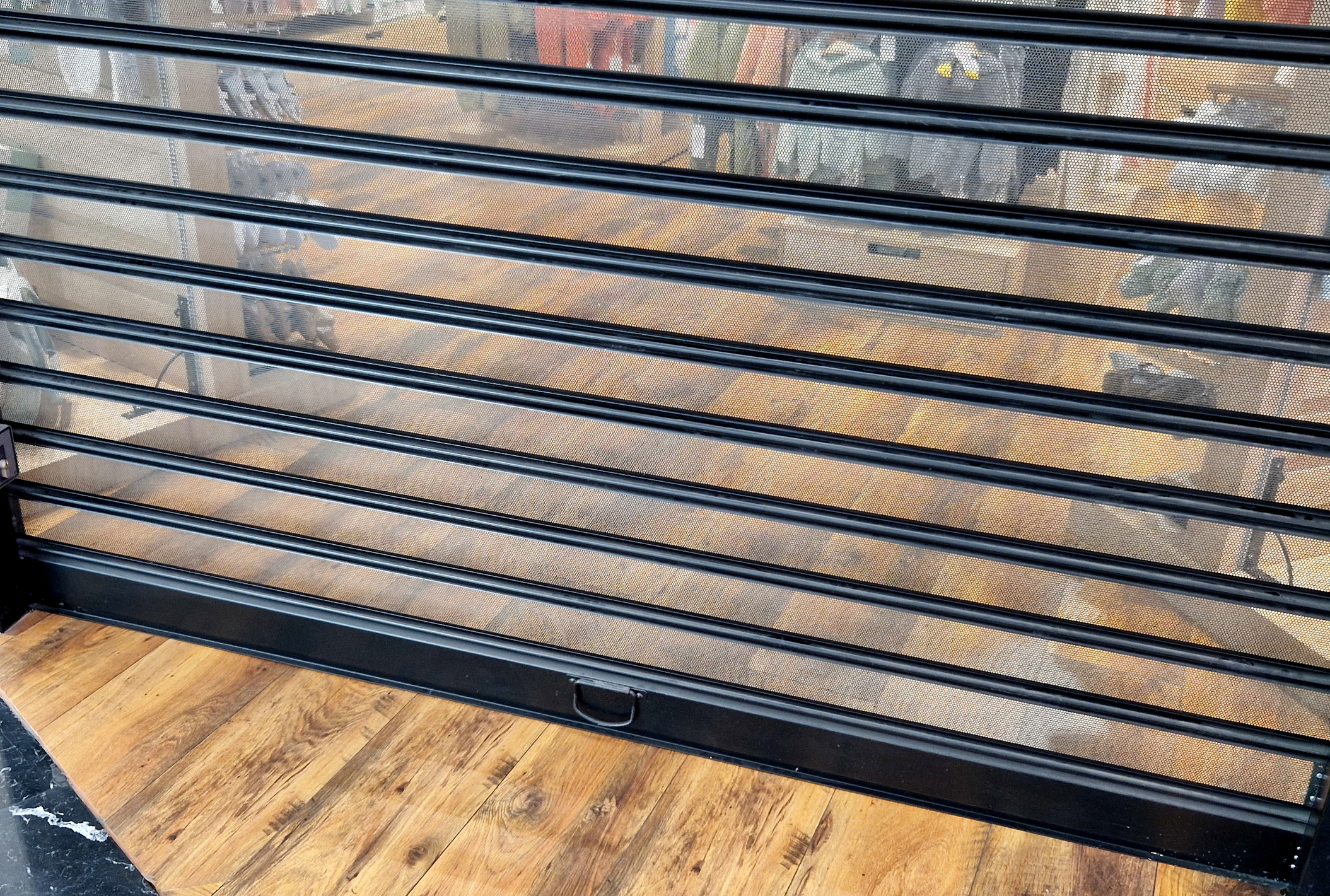
Perforated shutters have small round holes across the slats and give up to 22% visibility of the window behind, or more if there is a lit display inside.
Punched Roller Shutters
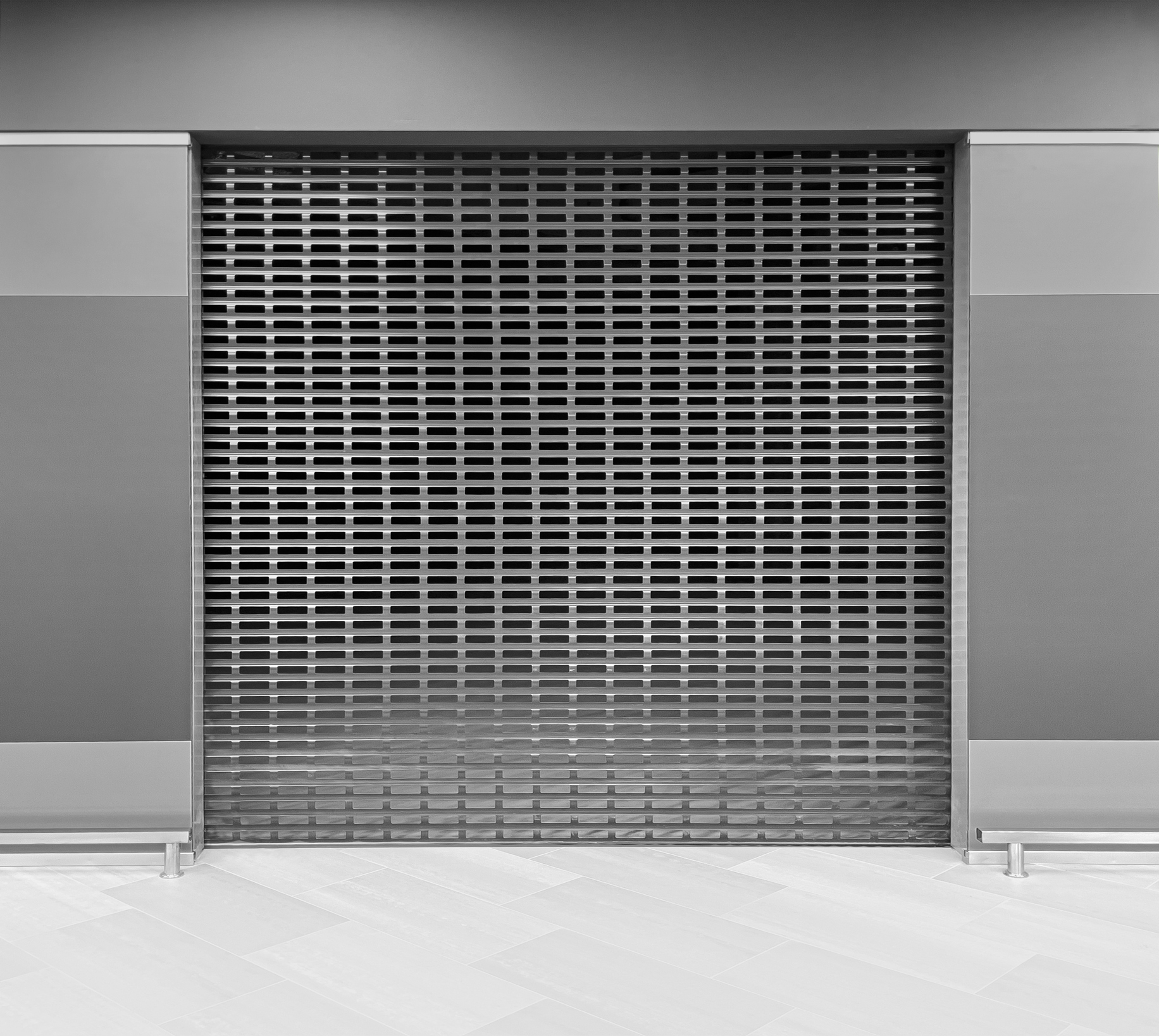
Punched roller shutters have larger rectangular holes, set in a brick bond or inline pattern, and show up to 58% of the window. There’s also a punched and glazed version with holes only in the top section, which keeps eye level visible and the lower half covered.
Polycarbonate Shutters
Polycarbonate shutters use transparent panels held between aluminium rods and give roughly 75% visibility. They only come in electric form, powered by a 240V single-phase unit, run from a rocker switch or a remote.
Rolling Grill Shutters
Rolling grill shutters, sometimes called chain link shutters, show up to 69% of what’s behind them. They’re useful for counters and bar areas, as well as shop fronts.
Every type can be powder-coated in any RAL colour, so electric shop front shutters can match your branding or a new aluminium shop front. If we’re fitting the front as well, we can build the shutter box into it. You can browse our selection of bespoke shop fronts to see what that looks like on a finished frontage.
Electric Roller Doors for Units, Warehouses, and Loading Bays
Electric roller doors from London Shop Fronts cover goods-in openings, unit fronts, and service yards on factories, industrial units, and warehouses.
An electric roller door works like a shop shutter on a bigger scale, and the motor does the lifting so that nobody has to haul a heavy curtain up by hand. Wide openings can be where electric operation really comes into its own, because a large manual curtain can be heavy, awkward work to operate.
If staff walk through the opening, electric roller shutter doors with a separate wicket door can let them in and out without opening the whole curtain. At work, any upward-opening door also needs a device that stops it falling back, under regulation 18 of the Workplace (Health, Safety and Welfare) Regulations 1992.
Looking for electric shutters for doors as well as windows? We can survey multiple openings on the same visit. However, we don’t provide electric shutters or doors for private home garages.
Motors, Controls, and Automation
Most electric roller shutters we fit at London Shop Fronts use a tubular motor, which is controlled by a key switch or a remote. For larger roller doors, we’ll recommend a suitable motor at the survey stage, once we know the size and weight of the curtain, while polycarbonate shutters usually use a 240V single-phase motor.
When it comes to controls, you have a number of options, and the right one for you will depend on the individual needs of your business.
An electric shutter remote lets you open up from the pavement or a van. You can also choose to have a wall-mounted keypad, or a key switch so only keyholders can open up.
Automatic roller shutter doors go a step further. They can open and close on a schedule or react to a motion sensor, while smart controls let you operate shutters from your phone. For grill shutters, we can also link the controls to your alarm and CCTV.
Simply tell us how you like to open up in the morning and lock up at night, and we’ll suggest controls that fit your needs.
Electric Shutter Safety and What a Proper Installation Includes
Regulation 18 of the Workplace Regulations sets the baseline for electric shutters at work. A powered door must have features that stop it trapping anyone and, where safety requires it, must work by hand unless it opens automatically when power fails.
In practice, that means installing safety devices on the closing edge. HSE’s guidance on keeping powered doors and gates safe says correctly chosen and fitted safety edges bring impact forces well below the limits in the standard. Light beams on their own, which detect people or objects in a doorway, usually aren’t classed as high-integrity safety devices.
When it comes to specific safety standards, there are two that apply. BS EN 12453 covers the safe use of power-operated doors (the current edition dates from 2017, amended in 2021), and the Door & Hardware Federation confirms that its scope includes powered rolling shutters and grills in retail premises. BS EN 13241 is the product standard for industrial, commercial, and garage doors.
Before we leave after installation, our installers check that every shutter is working properly and show you how to use it, including the manual override.
Electric or Manual Roller Shutters?
Electric roller shutters are more expensive than manual ones, but they’re much easier to use every day, especially for a wide shop front. Motorised roller shutters also let you add remotes, timers, and alarm links, which a hand-wound shutter can’t offer.
Manual shutters are the less expensive choice and need no access to power to operate. For smaller openings, we offer manual shutters, including crank handle and spring and lock versions. Our guide to electric and manual shutters compares the options in more detail.
How to Convert a Manual Roller Shutter to Electric
A manual shutter to electric roller shutter conversion is worth asking about if your shutter is in good order, but you’re finding it hard work or inconvenient to lift every day.
If you want to convert a manual shutter to electric, make sure you use a competent installer for it. In its legal responsibilities, HSE claims that the ‘converter’ or ‘installer’ of a manual to power-operated gate becomes its manufacturer by law, with all the duties and responsibilities that brings.
Do You Need Planning Permission for Electric Shop Shutters?
Electric shop shutters fitted outside the window glass usually need planning permission, and councils differ on which types they’ll accept. Lewisham Council, for example, says external security shutters need permission. It accepts open-grill or brick bond shutters but is unlikely to support solid or perforated metal roller shutters.
Other councils and London boroughs set their own rules, so it’s important to always check before you order. If an external shutter is likely to be refused, you can ask us about fitting one inside, behind the glass.
We can also help with the planning application process itself. Our guide to planning permission for shop fronts covers wider shop front changes too.

Our Electric Shutter Installation Process
Electric shutter door installation at London Shop Fronts follows similar steps for every job, from the first survey to handover. Our own team surveys the opening, makes the shutter in our UK factory, and then fits it, so one company is responsible from start to finish.
We fit electric shutters London-wide and right across the UK. Here’s how a job typically runs:
- Survey. We measure the opening and talk through your specific requirements for the shutter.
- Planning. If the shutter needs planning permission, we help you with the application.
- Manufacture. Once the design’s agreed, the shutter is made to measure in our UK factory and powder-coated in your colour.
- Fitting & electrical connection. We can fit out of hours so you don’t lose a day’s trading.
- Testing and handover. We check everything works, then show you the controls and the manual override.
- Aftercare. Our after-sales support stays with you once we’ve gone.
How Much Do Electric Roller Shutters Cost?
Electric roller shutters are priced per project, after a survey. The size of the opening, the shutter type, the motor, and how much customisation you want all affect the price, as do any security integrations. Safety devices and electrical work add to it too.
Comparing electric roller shutter prices online? Always be sure to check what’s included. A shutter delivered for you to fit isn’t directly comparable to one that’s installed, wired, safety-tested, and handed over with its paperwork.
At London Shop Fronts, every quotation comes with a price guarantee, and there’s no obligation.
Servicing and Repairs for Electric Shutters
To stay safe, electric shutters need maintaining, and owners of commercial premises are responsible for them. HSE’s guidance on legal responsibilities says owners and occupiers of commercial premises with powered gates have duties under the Workplace Regulations, including maintenance.
At London Shop Fronts, we can book an electric roller shutter service if you need one. We can also come out if your electric roller shutter isn’t working or starts to stall. Call 020 7112 9119 to speak to our friendly team.
Electric Shutter Projects
These examples are electric shutters we’ve made and fitted, each with the business, the type of shutter, and the controls all listed, so you can get a feel for our work.
You can find more examples of our work in our project gallery.
Electric Shutter FAQs
How Long Does It Take to Install an Electric Roller Shutter?
We make every shutter in our own UK factory, so we’re not waiting on someone else’s delivery date and times. We’ll agree the fitting day with you in advance, so you can plan a date around trading that works for you.
Can You Convert My Manual Shutter to Electric?
Whether it’s worth converting your shutter from manual to electric depends on the state of the shutter you’ve got, which we’ll check at the survey stage.
Either way, we’d recommend using a competent installer. HSE’s guidance on gates says whoever converts a manual gate to a powered gate takes on the manufacturer’s legal duties.
What Happens to an Electric Shutter in a Power Cut?
During a power cut, you can open or close an electric shutter by hand with the manual override, and our installers will show you how at the handover stage, once the shutter is installed.
That’s a legal point as well as a practical one. Under Regulation 18, a powered door at work must be operable by hand when required, unless it always opens automatically when power fails.
Do Electric Shutters Need Servicing?
Yes, electric shutters can need servicing from time to time. Owners and occupiers of commercial premises have a legal duty to maintain powered doors and gates, as HSE’s guidance explains. When we install your shutter, we’ll advise how often it should be serviced.
Are Electric Roller Shutters More Secure Than Manual Ones?
Electric roller shutters can be more secure than manual ones. A manual shutter is often easier to force open if it isn’t locked properly, whereas an electric one closes the same way every time.
The type of shutter also matters when it comes to security. A solid curtain, for example, hides everything from view when shut, while a grill or polycarbonate shutter keeps the display in view.
Can an Electric Shutter Be Operated by Remote or on a Timer?
Yes, an electric shutter can be operated by remote or timer. You can have a remote, a wall switch, a key switch, or a keypad, and the shutter can run on a schedule, react to a motion sensor, or link to a smart system.
Do You Install Electric Roller Doors for Homes or Garages?
No, we don’t install electric roller doors for private homes or garages. We fit electric shutters and roller doors for shops and commercial premises only.
Book an Electric Shutter Survey
Send us the site address and the rough size of the opening, plus the shutter type you’ve got in mind. Tell us if you’re replacing an old shutter or converting one, and we’ll call to book the survey.
Would you rather talk it through first? Call 020 7112 9119.